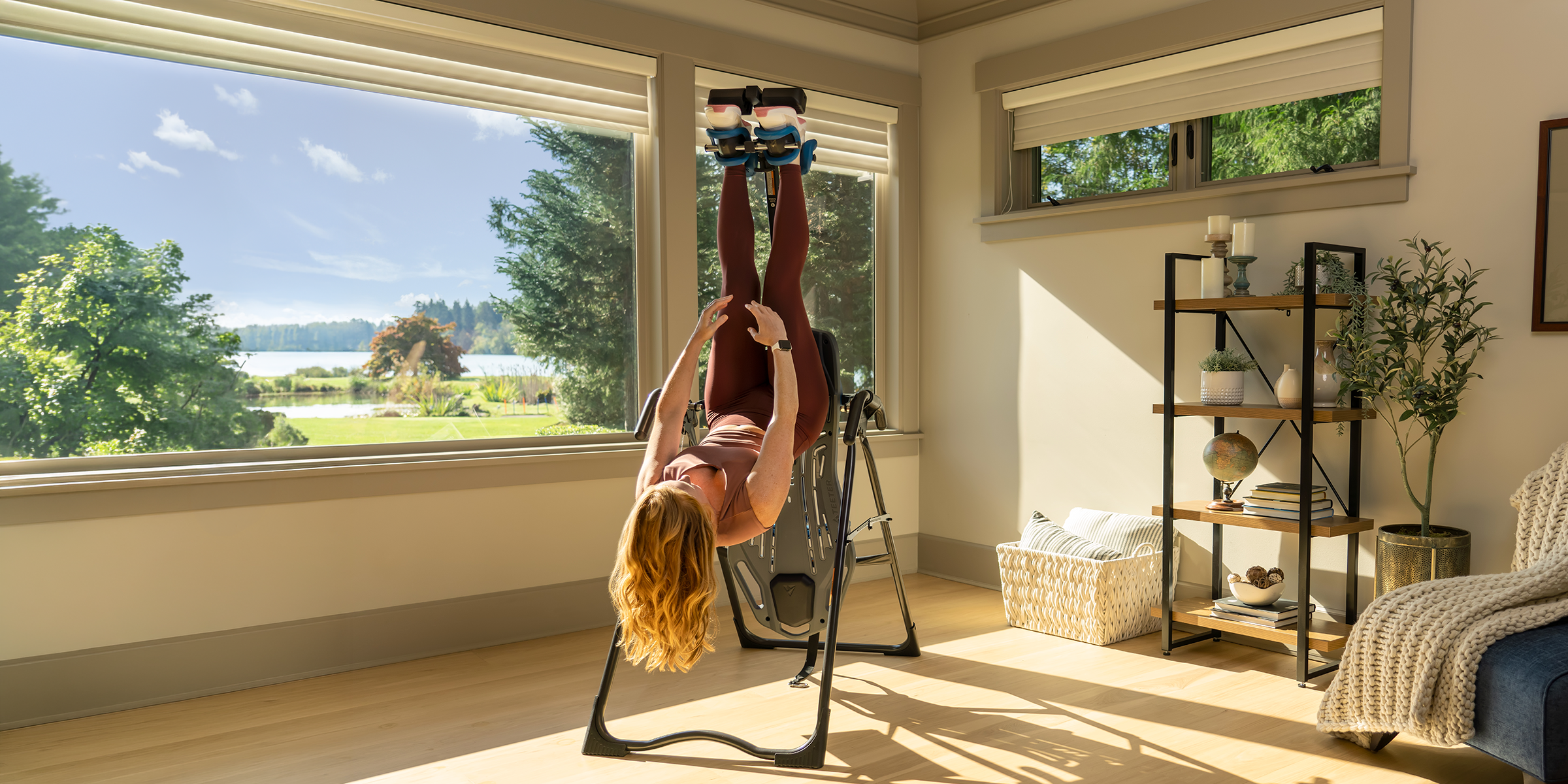
Most people start using an inversion table for back pain relief, decompression, or relaxation. But once you’re comfortable with inversion, your Teeter can also be used for stretching, movement, and bodyweight exercises that work your core, back, and legs.
The key is to build up gradually. Start by getting comfortable at partial inversion, then add gentle stretches and movement. More advanced exercises like inverted crunches, sit-ups, back extensions, and squats come later, once you’re comfortable with full inversion and can control the table with confidence.
Can You Exercise on an Inversion Table?
You don’t need to fully invert to add movement to your Teeter routine. Gentle stretches and torso movements can be done at comfortable inversion angles, while more advanced exercises like crunches, sit-ups, back extensions, and inverted squats are performed at full inversion, where you have more room to move.
If you’re new to inversion, start with the basics of how to use an inversion table and get comfortable controlling the table at partial angles before working up to more advanced movements. As you add more movement, focus on staying slow and controlled rather than using momentum. Stick with bodyweight exercises designed for the table instead of adding extra resistance.
Start With Inversion Table Stretches and Gentle Movement
Before jumping into strength exercises, try simple stretches and movements that help you get used to moving while inverted.

Add Decompression
Teeter Inversion Tables include Grip-and-Stretch Handholds that add gentle leverage while you stretch. At a comfortable angle, reach for a handhold or the A-frame and use a light pull to deepen the stretch. If your Teeter has Traction Handles, you can also use them for added leverage at shallower angles.
Overhead Stretch
Reach both arms overhead to stretch through your back, shoulders, and sides. Add gentle side bends or shoulder raises to help loosen tight muscles and deepen the stretch.
Torso Rotation
Torso rotations help stretch the muscles that support your spine while inverted. Reach across your body toward the opposite side of the frame and use a gentle pull to lengthen the muscles along your side. Slowly return to center and repeat on the other side.
Gentle Neck Stretch
Let your head rest naturally, then slowly turn toward one side. Return to center and repeat on the other side. Next, gently tilt your head from side to side, bringing your ear toward your shoulder without forcing the movement.
Strength Exercises on an Inversion Table
Once you’re comfortable with full inversion and know how to securely lock and release your Teeter, you can begin adding more challenging bodyweight exercises.
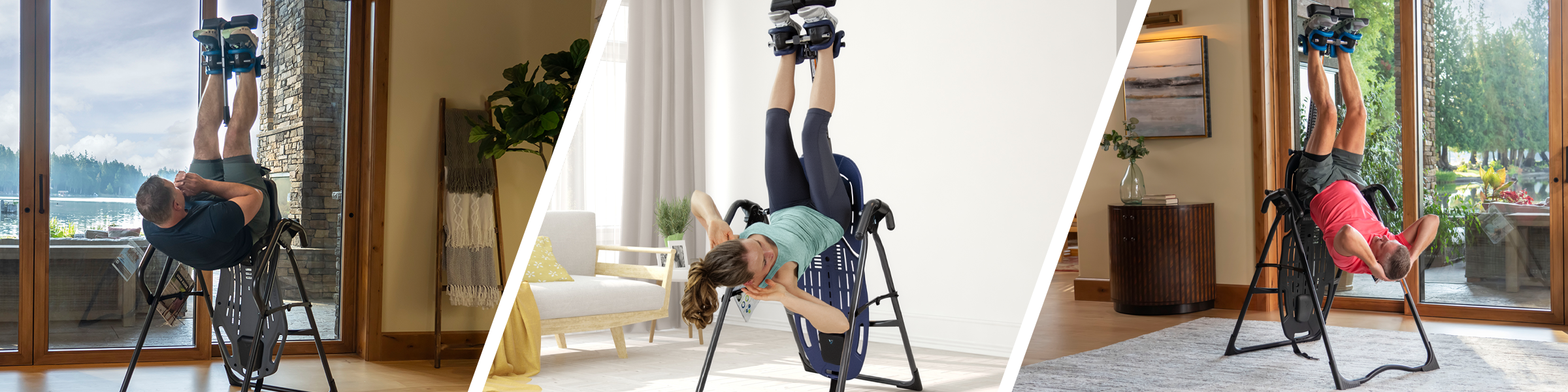

Inverted Back Extension
Works: Back, glutes, and hamstrings
Place your hands behind your head and engage the muscles along your back and glutes. Think of it like a reverse crunch. Slowly arch your upper body backward, pause briefly, then release with control.
Avoid swinging or using momentum to increase your range.
Inverted Crunch
Works: Abdominals
Cross your arms over your chest and engage your abdominal muscles. Slowly curl your upper body toward your knees, pause briefly, then lower yourself back down with control.
Keep the movement focused through your core rather than swinging yourself forward.
Oblique Inverted Crunch
Works: Abdominals and obliques
Once a standard inverted crunch feels comfortable, add a small amount of rotation.
As you lift, bring your right shoulder toward your left knee. Lower with control, then repeat toward the opposite side.
Rotate through your torso rather than pulling your head or neck forward.
Inverted Sit-Up
Works: Abdominals and hip flexors
Once you have inverted crunches down, work on completing the fuller range of motion with an inverted sit-up.
Bend your knees slightly and engage your core as you reach toward your knees and lift your torso. If needed, place your hands behind your knees to help complete the movement. Lower yourself slowly back to the starting position.
Remember that sitting up is an exercise, not the way to bring your inversion table upright. Always use the proper release and return technique for your Teeter.
Reverse Squat, or Inverted Squat
Works: Glutes, quadriceps, hamstrings, calves, and core
Reverse squats, also called inverted squats, work your leg muscles from a different position than a traditional squat.
Hold the A-frame legs for stability, bend your knees and draw your hips toward your heels, then slowly extend your legs back to the starting position.
Keep your grip steady and avoid bouncing or swinging through the movement.
More Ways to Train with Inversion
FitSpine Inversion Tables can support both stretching and bodyweight exercise, but Teeter also offers equipment designed with inverted training in mind.
The DEX II Inversion & Core Training System supports you at the hips instead of the ankles, making it well suited for inverted back extensions and core exercises. Its handles and base can also be used for reverse dips and modified push-ups for added upper-body strength work.
Teeter Gravity Boots allow full inversion from a compatible bar, providing freedom of movement for inverted crunches, sit-ups, squats, and other bodyweight exercises.
Adding Inversion to Your Workout Routine
Inversion can complement the strength and cardio work you already do without replacing it.
Before a workout, you might use your Teeter for gentle stretching and movement. Afterward, it can be a place to stretch, decompress, and relax.
You can also use inversion separately from your workouts whenever it fits your routine. For more guidance on session length and frequency, see how long and how often to invert.
Follow Along with Teeter Move
If you’d rather follow a guided routine, the free Teeter Move app includes FitSpine classes for different experience levels and goals.
Newer users can start with 8 Min Beginner Stretching & Relaxation, then progress to 10 Min Intermediate Stretching & Relaxation as they get more comfortable. Experienced inverters can move into classes like 10 Min Advanced Strength & Core for more challenging core and lower-body work.
You’ll also find routines focused on decompression, intermittent traction, oscillation, and stretching, so you can choose a session that fits what you want from your inversion routine.
Make Inversion Work for Your Routine
Inversion can be more than a way to stretch and decompress. As you become more comfortable, it can also become part of your routine for core strength, flexibility, and movement.
Whether you’re using a FitSpine Inversion Table, DEX II, or Gravity Boots, there’s room to build on the basics at your own pace. And with guided routines in Teeter Move, you can explore new stretches and exercises as your confidence grows. Start with the movements that feel comfortable, build from there, and make inversion part of your routine in a way that works for you.
Explore More Ways to Invert
From everyday stretching and decompression to more advanced inverted exercise, find the Teeter setup that fits your routine.

 Discover Teeter Blog