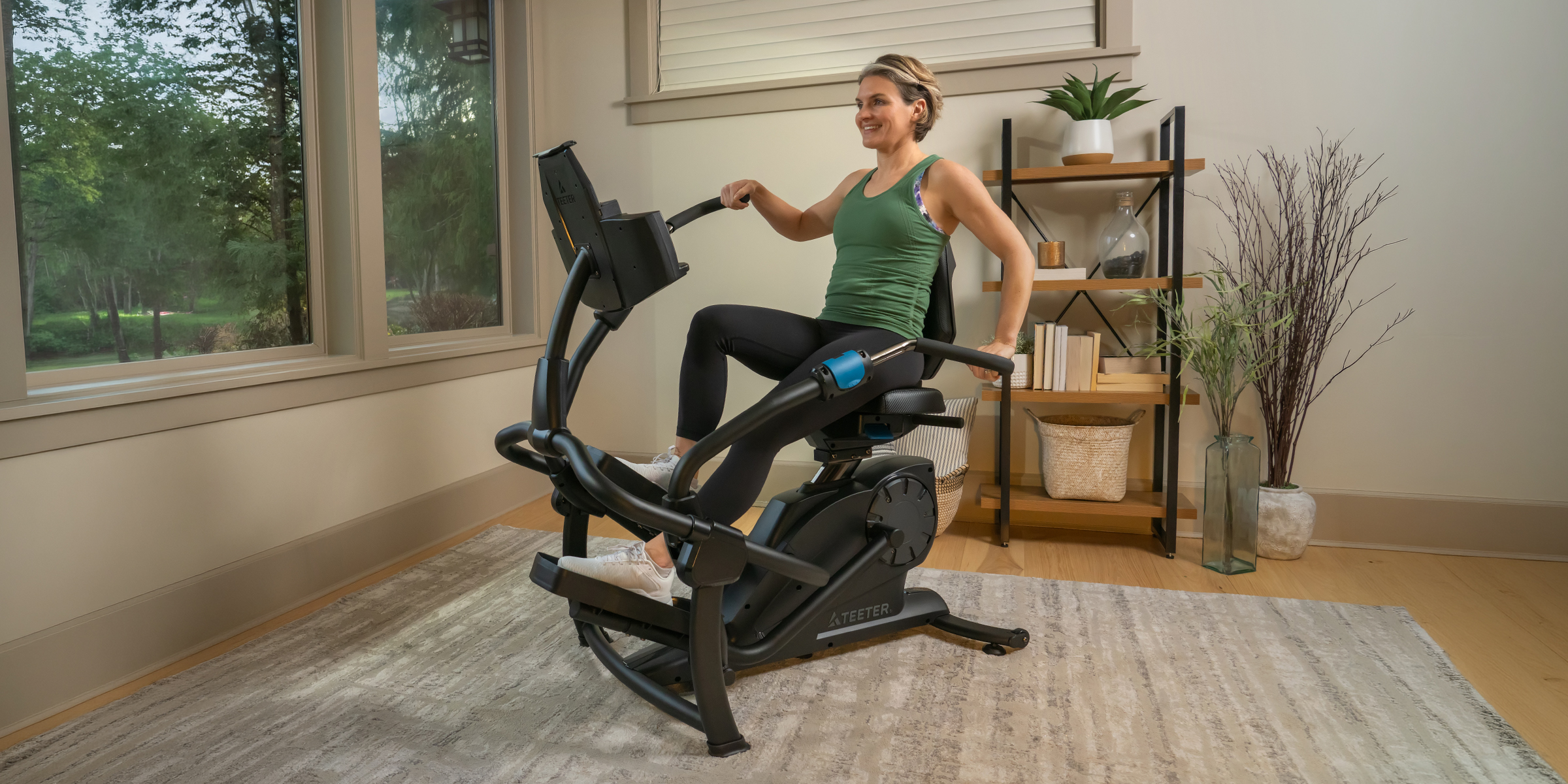
You might have used one in physical therapy without ever knowing its name: a sitting exercise machine with a backrest for support, pedals that move in a smooth stepping motion, and handles that allow your arms to move along with your legs.
This kind of equipment is called a recumbent cross trainer. It provides a comfortable seated position while offering a low-impact way to get your heart rate up and work both your upper and lower body. This combination makes it common in rehab programs and is a popular choice for people who want a more comfortable way to exercise at home.
What Is a Recumbent Cross Trainer?
The name describes how the machine works. Recumbent means you exercise from a seated, reclined position. Cross trainer refers to equipment designed to involve both the upper and lower body.
Unlike a recumbent bike, where your feet pedal in a circular motion, a recumbent cross trainer typically uses a more natural stepping motion. Moving handles allow your arms to work along with your legs, and on some machines, you can adjust how much effort comes from your upper or lower body.
You may also see this type of equipment referred to as a seated cross trainer.
The seat and backrest provide support throughout the workout, which can make a recumbent cross trainer a good option for people who prefer seated exercise or find upright cardio equipment uncomfortable.
How Is a Recumbent Cross Trainer Different From a Recumbent Bike or Elliptical?
Recumbent cross trainers share features with both recumbent bikes and ellipticals, but the way you move on each machine is different.
Recumbent Cross Trainer vs. Recumbent Bike
Both machines allow you to exercise from a seated position with back support.
The main difference is the movement. A recumbent bike uses a circular pedaling motion and primarily works the lower body. A recumbent cross trainer uses a stepping motion and adds moving handles so your upper and lower body can work together.
The differences become especially important when choosing between a recumbent cross trainer and a recumbent bike, since both provide seated support but use very different movement patterns.
Recumbent Cross Trainer vs. Elliptical
A traditional elliptical is used from a standing position. Your feet stay on the pedals while your body moves through an elliptical path, often with handles that engage the upper body as well.
A recumbent cross trainer uses a similar smooth, continuous style of movement, but you remain seated with your back supported. This removes the need to support your full body weight while exercising and offers a different experience for people who prefer seated cardio.
Why Are Recumbent Cross Trainers Used in Physical Therapy?
Recumbent cross trainers are common in physical therapy and rehabilitation settings because they offer a supported way to keep the body moving.
The seated position provides stability while the stepping motion allows the hips, knees, and ankles to move through a controlled range of motion. Moving handles also give the upper body a role in the exercise.
Depending on the person and their rehabilitation plan, that design can make it possible to combine cardiovascular exercise, strength, and movement in one machine.
Another useful feature is the ability to shift effort between the arms and legs. Someone working on lower-body mobility, for example, may be able to use more upper-body effort to help guide the stepping motion.
Physical therapist Dr. Jo demonstrates the Teeter FreeStep LT7 and explains how a recumbent cross trainer can provide smooth, low-impact exercise with support for both upper- and lower-body movement.
Who Is a Recumbent Cross Trainer For?
Recumbent cross trainers can work well for a range of people, especially those who prefer a seated exercise position.
People Looking for Lower-Impact Cardio
Running, walking, or standing cardio equipment may not be comfortable for everyone. A recumbent cross trainer keeps you seated while allowing you to raise your heart rate and keep your body moving.
For people with knee discomfort, choosing exercise equipment that’s easier on bad knees can help make regular movement more manageable.
People Transitioning from Physical Therapy to Home Exercise
If you first used a seated cross trainer during physical therapy and liked the way it felt, you may want a similar type of exercise equipment at home.
Having access to a familiar movement pattern can make it easier to build regular activity into your routine once formal therapy has ended. It can also provide a comfortable way to continue physical therapy at home after joint replacement and stay active between or after formal therapy sessions.
Older Adults
A recumbent cross trainer may also appeal to older adults who prefer a seated workout with back support rather than exercising from a standing position.
The combination of low-impact movement, adjustable resistance, and a stable seat can make this type of equipment easier to approach than some upright cardio machines. That supported approach also fits into the broader role of low-impact exercise in long-term joint health, especially for people who want to stay active without relying on higher-impact workouts.
Anyone Who Wants Seated Full-Body Exercise
Recumbent equipment is sometimes associated primarily with leg workouts, but a cross trainer is designed to involve the upper body as well.
Moving handles let you work your arms and legs together, or shift more of the effort toward one area depending on how you want to exercise.

What Are the Benefits of a Recumbent Cross Trainer?
The main recumbent cross trainer benefits come from combining several types of exercise in one supported movement.
A recumbent cross trainer can provide:
- Low-impact cardiovascular exercise
- Seated back support
- Full body exercise with upper- and lower-body movement
- Adjustable resistance
- The ability to emphasize the arms or legs
- A stable alternative to standing cardio equipment
Because resistance can be adjusted, the same machine can also support different workout intensities as your goals or fitness level change.
Some models include additional features such as workout programs, performance tracking, or media holders, while others keep the experience simple with manual resistance and basic workout data.
What to Look for in a Recumbent Cross Trainer for Home
If you’re considering a recumbent cross trainer for home use, a few features can make a significant difference in how comfortable and practical the machine is.
Seat Comfort and Support
You’ll spend the entire workout seated, so the seat deserves close attention.
Look at the amount of padding, the shape and support of the backrest, and how the seat adjusts. The right position should allow you to reach the pedals comfortably without feeling cramped or overstretched.
Adjustability
A recumbent cross trainer should be able to accommodate your height and body position.
Look for adjustable seating and handles that allow you to find a comfortable range of motion. If more than one person will use the machine, easy adjustments become even more important.
Weight Capacity
Always check the manufacturer’s listed weight capacity before buying.
Choosing equipment designed for the user’s weight helps ensure that the machine is being used within the specifications it was designed and tested for.
Ease of Getting On and Off
This is easy to overlook until the machine is already in your home.
Consider how open the path to the seat is, whether handles or other stable surfaces are available for support, and whether the pedals or handles move while you’re getting into position.
For someone with limited mobility, these details can be just as important as the workout itself.
Footprint
The machines used in rehabilitation clinics can be large, so pay attention to how much floor space a home model requires.
Measure the area where you plan to keep the machine, then allow additional room to approach the seat and get on and off comfortably.
Resistance and Workout Options
Some people prefer a simple workout where they choose a resistance level and start moving. Others like programmed workouts that automatically vary resistance or provide more structure.
Think about how you actually like to exercise rather than assuming more features are always better.
Bringing the Recumbent Cross Trainer Experience Home
The Teeter FreeStep brings the recumbent cross trainer format into a design intended for home exercise, combining a supportive seated position with smooth upper- and lower-body movement.
The FreeStep LT1 and LT3 focus on the core workout experience, with adjustable resistance and the ability to use your arms and legs together or emphasize one over the other.
The FreeStep LT7 adds features for people who want more workout guidance and feedback. Its nine-inch display tracks seven performance metrics, and 21 pre-programmed workouts can automatically vary resistance throughout the session.
The LT7 also includes a locking feature that secures the moving components while you’re getting on or off the machine. Dr. Jo demonstrates that feature in the video above.
All FreeStep models use the same recumbent cross trainer approach. The difference comes down largely to whether you prefer a simpler setup or want features like programmed workouts and a larger performance display.
Is a Recumbent Cross Trainer Right for You?
A recumbent cross trainer can be a practical option for anyone looking for a supportive, low-impact way to combine cardio with upper- and lower-body movement. Its seated design, adjustable resistance, and full-body motion make it a flexible choice for a range of fitness levels and goals.
When choosing one for home, focus on finding a machine that feels comfortable, fits your space, and offers the features you’ll actually use. The right setup is the one that makes regular movement easier to work into your routine.
Bring Low-Impact, Full-Body Exercise Home
Explore Teeter FreeStep recumbent cross trainers and find the model that fits the way you want to move.

 Discover Teeter Blog