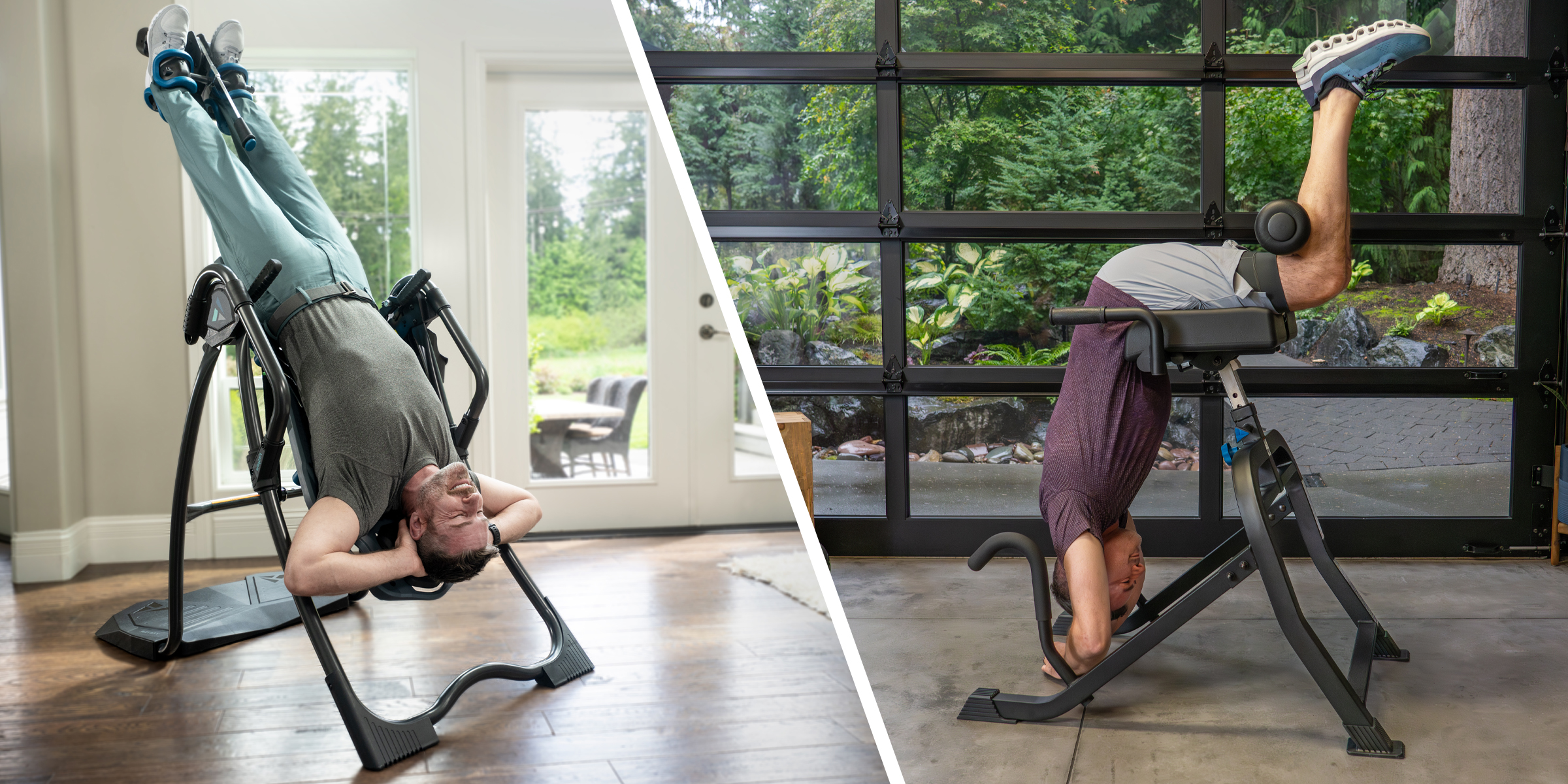
The biggest difference between a Teeter inversion table and the DEX II is how your body is positioned during decompression. An inversion table reclines you backward with ankle support. The DEX II supports you from the hips as you rotate forward.
Both use gravity-assisted decompression, but the experience is different from the first moment you get into position. One feels more like lying back into a full-body stretch. The other feels more focused, with no ankle loading and a forward-supported setup.
Teeter has been designing inversion and back care equipment since 1981, with products built around low-impact movement, decompression, and at-home support. This comparison is not about choosing the “better” product. It is about choosing the position, support style, and routine that feel like the right fit for you.
The Quick Difference: Recline vs. Forward Decompression
An inversion table holds you in a reclined, ankle-supported position and rotates your whole body backward. The DEX II holds you in a forward-rotating, hip-supported position with your knees and hips bent.
Both use gravity-assisted decompression, also known as spinal traction. In simple terms, your own body weight helps create gentle elongation of the spine and supporting muscles. What changes is where your body is supported and how the stretch feels.
That difference is often what guides someone toward one system or the other. Some people prefer the familiar feeling of lying back on an inversion table. Others prefer the more grounded, forward-facing feel of the DEX II, especially if they want to avoid ankle loading or focus more on the lower back.
How Inversion Tables Decompress the Spine

On an inversion table, the stretch tends to feel more passive and full-body. You recline to a comfortable angle, settle in, and let gravity do most of the work. For many users, that creates a gentle lengthening through the back which may help ease pressure and relax tight muscles.
You do not have to go fully upside down to use an inversion table. All Teeter inversion tables let you control the angle, so you can start with a gentle recline and ease into a deeper position as you get more comfortable. For many users, partial inversion is enough to feel a stretch, especially when they are just getting started.
Because inversion tables allow users to recline gradually and control their angle of rotation, they remain the most recognizable and widely used form of inversion. Teeter inversion tables also include patented design features focused on comfort, control, and user experience, from ergonomic ankle supports to precision rotation and adjustable positioning.
How the DEX II Decompression System Works

That bent-knee, bent-hip position is the heart of the design. It is designed to place more emphasis on the lower back, which may feel more targeted than a full-body reclined inversion experience.
Because your weight rests on your hips and thighs rather than your ankles, there is no ankle loading involved. That can be appealing for users who do not like the idea of hanging from their ankles or who simply prefer the more familiar feeling of forward rotation. It also removes the ankle pressure that some people may find uncomfortable on traditional inversion equipment.
Teeter also positions the DEX II as a decompression and core training system. The same platform supports controlled back extensions and core work, so it can serve as both a recovery-focused tool and a strength station in one footprint. With a listed weight capacity of up to 350 lb, it is built as a sturdy option for home use. That added versatility is a secondary benefit, but it is often part of why someone leans toward the DEX II.
Recline vs. Forward Inversion: What the Difference Means for You
Neither position is better for everyone. They simply fit different bodies and different preferences.
Recline inversion tends to feel familiar and full-body. You lie back, your body rotates as one unit, and gravity helps create a stretch through the spine. It is the position most people picture when they think of inversion.
If you want a relax-and-stretch experience that feels passive and full-body, an inversion table may fit that well. It also gives you control over your angle, so you can start with a mild recline instead of going fully inverted right away.
Forward decompression appeals to a different set of preferences. If the idea of hanging by your ankles is not for you, the hip-supported position removes that part of the experience. If your focus is the lower back, the 90/90 setup is designed to place more emphasis there. And if you also want the option to build core and back strength on the same equipment, the forward setup may match what you are looking for.
Inversion Table vs. DEX II Comparison Chart
← Scroll to see full table →
| Feature | Inversion Table | DEX II |
|---|---|---|
| Body position | Reclined, full-body rotation backward | Forward-rotating position with knees and hips bent |
| Main support point | Ankles | Hips and thighs |
| Decompression experience | Broad, full-body reclined stretch | Lower-back-focused forward stretch |
| Inversion control | Adjustable angle based on comfort level | Controlled forward pivot with support handles |
| Lower-back focus | General spinal decompression experience | Designed to place more emphasis on the lumbar area |
| Exercise capability | Supports decompression, stretching, and optional inverted core and strength exercises | Built for decompression plus controlled back extension, core, and upper-body exercises |
| Storage & footprint | Folds for storage between sessions | Larger footprint, often left set up as a training station |
| Best for | A familiar, full-body reclined stretch | Lower-back-focused decompression with no ankle pressure and added strength versatility |
Which One Is Right for You?
If you’re drawn to the classic inversion experience, an inversion table is probably the better fit. You can recline at your own pace, adjust the angle to your comfort level, and enjoy a full-body stretch while letting gravity do the work. It’s also a good option if you want something that can fold away when you’re finished.
The DEX II may be a better choice if you prefer a forward-supported position, want to avoid pressure on the ankles, desire a more targeted lumbar decompression experience, or like the idea of combining decompression with core and back-extension exercises. Since it’s usually left assembled, it works best if you have a dedicated space for it.
Some users even incorporate both styles into their routines, using an inversion table for a more passive, full-body stretch and the DEX II for forward-supported decompression and core-focused exercise.
"I use [the DEX II] to loosen tight upper back in the morning and to do crunches, stretches and back raises as well as triceps exercises with the handles. Find I'm using it more than the inversion table, which I now use more for relaxing and stretching."Deirdre M, MN
Either way, you are choosing a Teeter decompression product built with safety and durability in mind. Both the inversion table and the DEX II are FDA-registered medical devices, so the decision comes down less to credibility and more to which position feels right for your body.
Ready to Find Your Decompression Setup?
Whether you prefer to recline back or lean forward, Teeter gives you more than one way to decompress at home.

 Discover Teeter Blog