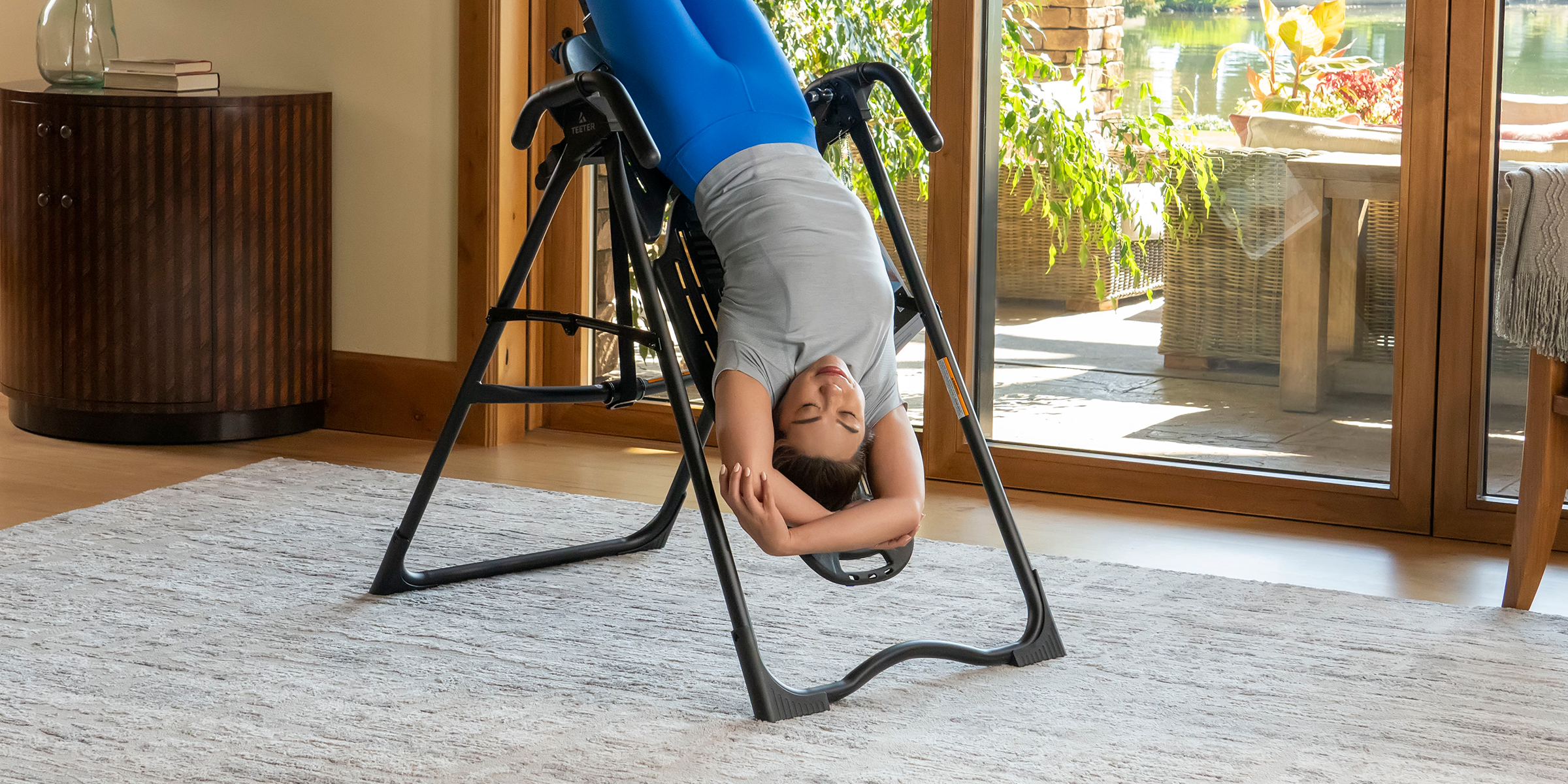
Your back muscles are active for most of the day. They help keep you upright, support your spine while you move, and constantly adjust as you sit, stand, bend, or reach. When these muscles stay engaged for long periods, your back might start to feel tired, stiff, or almost like it never fully relaxes.
Inversion temporarily changes your body position and the way your spine and surrounding muscles are supported. But does inversion actually change how hard those muscles are working? Surface EMG scans provide a way to visualize how electrical activity in the back muscles changes before, during, and after inversion.
Why Back Muscles Stay Active Throughout the Day
The erector spinae muscles are along the spine and help keep good posture, straighten the back, and control movement. The deeper core muscles, like the transverse abdominis, work together with back and pelvic muscles to keep the body stable.
These muscles do not need to be lifting something heavy to become tired. Sitting at a desk, standing for a long shift, driving, or simply holding the same position for hours can keep them active at a low level for a long time. Repeated bending, twisting, and reaching may also place more demand on one area than another.
Sometimes increased muscle activity is protective. When part of the back feels sore, irritated, or vulnerable, the nervous system may signal nearby muscles to tighten and limit movement. This response, often called muscle guarding, can be helpful in the short term but may contribute to lingering stiffness when it continues.
How Your Back Muscles Respond to Inversion
When you stand upright, gravity puts some pressure on your spine, and the muscles around it help support your posture and move you properly.
An inversion table doesn’t make your body weight disappear. Instead, it supports your body while gravity pulls in the opposite direction. This can gently stretch the spine, which some refer to as traction or decompression, and may temporarily make your spine feel slightly longer.
Changing your position also shifts what your postural muscles are asked to do. For example, the erector spinae muscles no longer need to keep you upright, since the table is supporting your body instead of needing to stay balanced over your feet.
This doesn’t mean all your muscles instantly relax. Some people may tense up at first because being upside down feels unfamiliar, and your muscles still work to control movement and keep you stable as the table rotates.
The more important question is whether supporting the body in an inverted position changes how hard those muscles are working. Surface EMG provides one way to observe changes in muscle activity before, during and after inversion.
What Surface EMG Measures
Electromyography (EMG) measures the electrical signals produced when muscles are active. Surface EMG uses sensors placed on the skin to detect signals from muscles near the surface and display them as a visual reading.
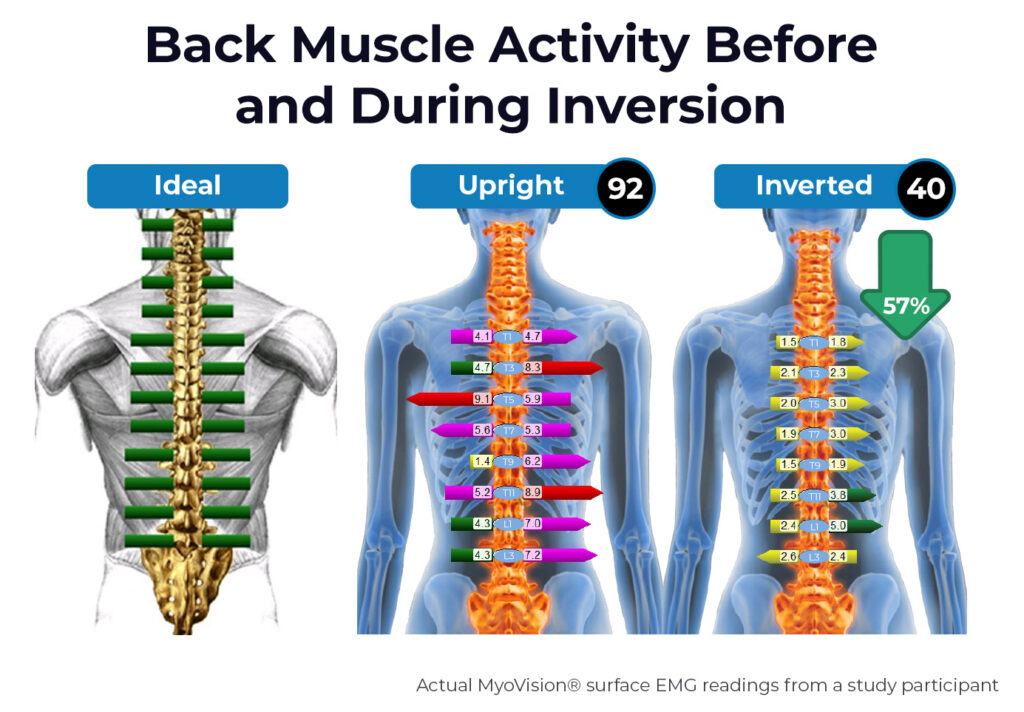
In the MyoVision display, taller bars indicate greater electrical activity in the muscles beneath the sensors. Arrows point to any side-to-side imbalance in activity.
While surface EMG can compare readings from different positions or times, it doesn’t directly measure how tight or strong the muscles are, or if there’s pain, spinal alignment issues, or pressure on discs or nerves. Factors like where the sensors are placed, body movement, posture, and how deep the muscles are can affect the results.
A lower reading means less electrical activity was detected at that moment. This suggests the muscle was less active, but it does not explain why the activity changed or confirm that the muscle fully relaxed.
MyoVision was created to help make these signals clearer and easier to compare, and that is why it was used to compare muscle activity before, during, and after inversion.
How the MyoVision Inversion Scans Were Performed
In July 2013, MyoVision founder David Marcarian, MA, carried out surface EMG scans on four people with different body types and back health histories.
First, each person had a baseline scan while standing upright and supported on a Teeter inversion table. Then, they tilted backward to a 60-degree angle and stayed in that position for three minutes. While inverted, another scan was taken. After they returned to an upright position, a third scan was done three minutes later.

What Changed in the MyoVision Readings
All four participants showed lower surface EMG readings during and after inversion, with an average decrease of 37 percent after three minutes. In one participant, the score dropped from 92 upright to 40 during inversion, a 57 percent decrease.
These findings suggest that the activity of certain back muscles decreased during inversion. Similar patterns have been reported in earlier research examining lumbar muscle activity during inversion.
What the Findings Suggest
The scans suggest that inversion temporarily reduces the activity of certain surface-level back muscles. Because the table supports the body and changes the direction of spinal loading, those muscles no longer need to work in the same way they do while you are upright.
That reduction in muscle activity may help explain why inversion often feels relaxing when the back is tight, guarded, or overworked.
The clearest takeaway is that inversion was associated with lower recorded muscle activity during and shortly after the test. More research is needed to better understand how consistently that response occurs and how long it lasts.
Giving Overworked Back Muscles a Chance to Relax
The MyoVision scans suggest that when the body is supported in an inverted position, some back muscles may become less active for a short time. Along with the temporary traction created through the spine, that shift may help explain why inversion can feel relieving when your back feels tight, tired, or compressed.
For people who want a supported way to experience that traction at home, a Teeter Inversion Table lets you control the angle and ease into inversion gradually. The table supports your body as the direction of spinal loading changes, giving the muscles around your spine a chance to do less of the work required to hold you upright. Teeter FitSpine inversion tables are FDA-registered devices and UL Safety Certified, and Teeter is the only inversion brand independently tested to that safety standard.
Your back works hard to hold you up all day. Giving it a chance to stop working quite so hard, even for a few minutes, is a small thing that can change how the rest of your day feels.
A Simple Way to Decompress at Home
Teeter FitSpine inversion tables help you relax, decompress, and build a recovery routine that fits your body.

 Discover Teeter Blog