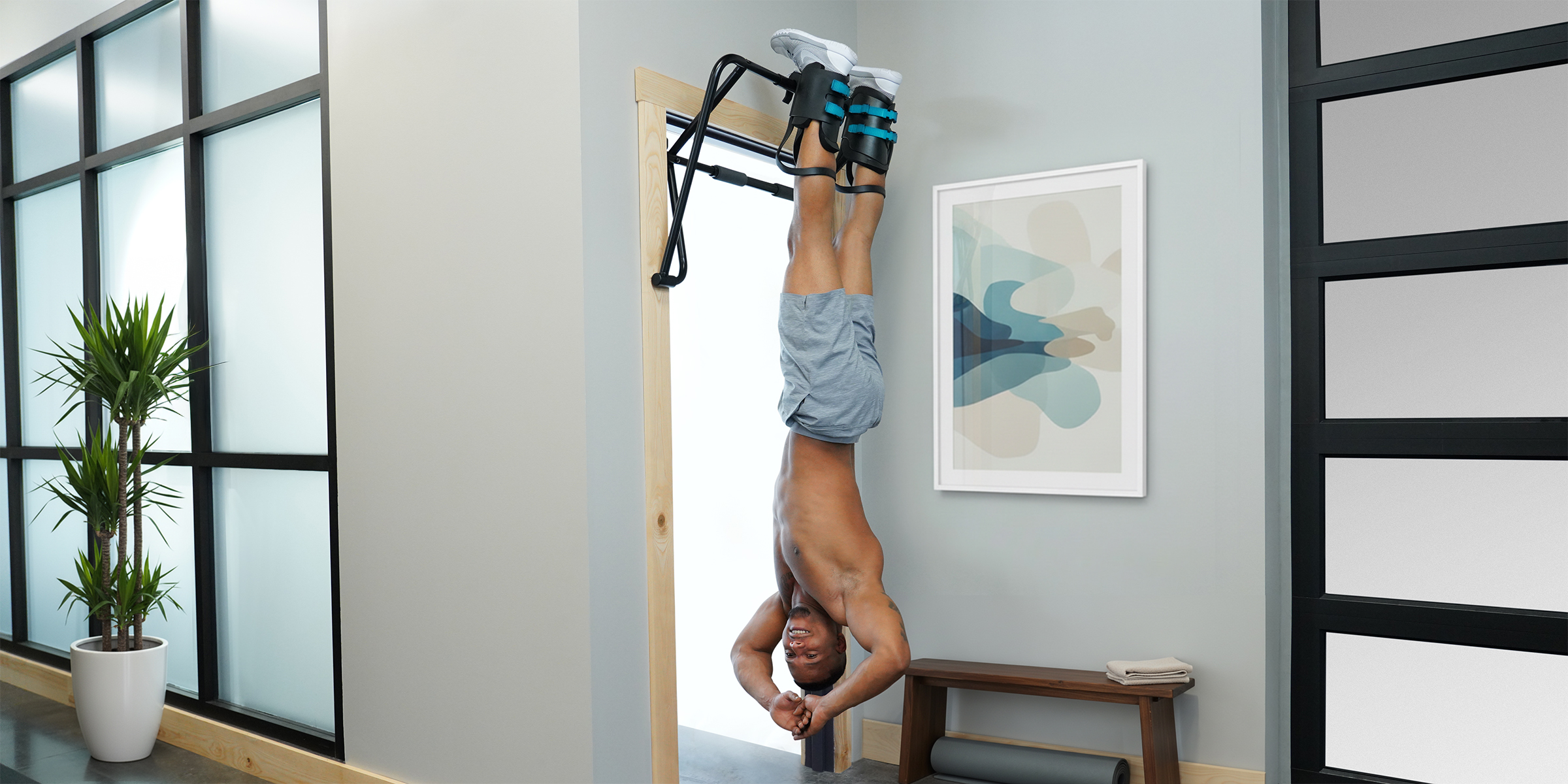
If you’re looking for a more active way to incorporate inversion into your routine, gravity boots are worth a look. Used with a compatible bar or rack, they allow you to hang fully inverted for decompression and inverted exercise.
For some people, that means a convenient way to decompress after long days of sitting, standing, or training. For others, it is a way to add a new challenge to core and lower-body workouts without dedicating space to a full inversion table.
What Are Gravity Boots?
Gravity boots are padded cuffs that fit around your ankles and lower legs, allowing you to hang upside down from a bar or inversion rack. They are called “boots,” but they are not worn like regular shoes. Instead, they wrap securely around your ankles and connect to a strong bar using built-in hooks.
When used correctly, gravity boots keep your body in a fully inverted position, so your spine isn’t under the same downward pressure you feel during the day when you are sitting, standing, or moving around upright.
Some people use gravity boots mainly for inversion and decompression, but they can also be used for inverted exercises like crunches, sit-ups, and lower-body movements. For people with a compatible setup, they offer a simple way to incorporate both decompression and strength work into an exercise routine.
How Gravity Boots Work
Inversion is a natural form of traction that uses your body weight and gravity to help decompress the spine. When you hang inverted, this stretch can help elongate the spine and reduce pressure on the discs and weight-bearing joints.
Many people describe this as a lengthening or releasing feeling in the back after long periods of sitting or standing. That is one reason inversion has remained popular for decades, especially among people looking for a way to decompress at home.
Gravity boots and inversion tables both use inversion to help decompress the spine, but they offer different experiences. Gravity boots attach to a compatible bar or rack and allow the body to hang freely, while an inversion table supports the body on a backrest and allows for controlled, adjustable inversion.
That makes gravity boots a strong option for people who want a lighter setup or want to incorporate inverted exercises into their routine, while an inversion table remains an excellent choice for comfortable, supported decompression at home.
Why People Use Gravity Boots

For others, the appeal is more performance-focused. Gravity boots can be used for inverted crunches, sit-ups, leg raises, and lower-body movements, making them a practical option for people who want to build core strength and add a new challenge to their exercise routine. That combination of decompression and exercise is one reason gravity boots have remained popular among athletes, gym-goers, and other active users.
They can also be a good fit for people who want a lighter, more portable inversion option. Used with a compatible bar or rack, gravity boots can work at home or at the gym, making it easier to bring inversion into an existing setup without adding another large piece of equipment.
This combination of recovery, performance, and versatility is what has kept gravity boots relevant across a range of users, from everyday recovery routines to more demanding training environments. Teeter has worked with Army units to incorporate inverted decompression into training and recovery, and it continues to be used by high-level performers focused on recovery, mobility, and long-term performance.
How to Use Gravity Boots Safely
Before using gravity boots, make sure your setup is secure and compatible. The bar or rack should be durable, properly installed, and able to support your body weight during inversion.
When using gravity boots at the gym, make sure the bar is the correct size and strength. The bar should be no more than 1.25″ in diameter and must be securely mounted and able to support your full body weight without movement or flex.
Always check that both boots are fastened correctly and that each hook is fully engaged before hanging.
If you are new to inversion, start with a shorter session so your body can adjust to the position. Having someone nearby for your first few sessions can also help you feel more comfortable as you get used to mounting, inverting, and returning upright.
Gravity boots are not right for everyone. If you have high blood pressure, glaucoma, heart-related conditions, osteoporosis, are pregnant, or have a history of spinal injury or surgery, talk with your doctor before getting started.
Move slowly as you are getting used to the process. When you are ready to come back up, take your time and pause halfway, holding onto the grips with your head upright. Complete your dismount, then give yourself a moment before stepping away from the bar. A gradual approach helps you get comfortable with inversion while reducing the chance of feeling lightheaded.
Gravity Boots vs. Inversion Tables
Gravity boots and inversion tables both support inversion, but they do so in different ways.
An inversion table supports the body on a backrest and allows for controlled, adjustable inversion. You can move gradually between angles, from partial inversion to full inversion, and incorporate gentle oscillation for a more dynamic decompression experience. That level of control makes it a great option for people who prioritize comfort, ease of use and a more supported approach at home.
Gravity boots create a free-hanging setup using a compatible bar or rack, placing the body in full inversion. This allows for greater freedom of movement and inverted exercises, and is also a good fit for people who want a lighter, more portable option or who already have equipment they can use.
It is less a matter of one being better than the other and more a matter of which setup best fits your goals, your space, and the kind of inversion experience you want. For some people, that will be the control and support of an inversion table. For others, gravity boots offer a more flexible, exercise-focused approach. And for some, the two can complement each other within a broader training and recovery routine.
Teeter Gravity Boots and At-Home Setup Options
Teeter Gravity Boots are designed to make inversion training comfortable, secure, and easy to incorporate into your routine. Their lightweight, portable design makes them a practical option for people who want to invert at home or at the gym.
Comfort is a big part of the design. Teeter Gravity Boots feature thick foam liners and dual-lock ratchet buckles for a secure, adjustable fit, while optional calf loops can help reduce pressure on the knees and tops of the feet.
They are also built for durability. The boots are made with lightweight DuPont Hytrel material, reinforced with a 40% glass and nylon alloy, and finished with 2.5-inch non-skid hooks to help reduce movement along the bar while inverted.
For people who want a more complete home setup, Teeter also offers the Inversion System, which pairs Gravity Boots with a versatile doorway chin-up bar for inversion, bodyweight training, resistance bands, suspension straps, and heavy bag workouts. Its dual-bar design allows for more freedom of movement, while screw-mounted brackets create a secure, adjustable fit for solid wood doorframes 28 to 36 inches wide.
Getting Started with Gravity Boots
Gravity boots are best for people who want a more active approach to inversion and already have, or are planning for, a compatible setup. They can support decompression, recovery, and inverted exercise, but the right fit comes down to your goals, your space, and how you want to use inversion in your routine.
If that sounds like what you are looking for, Teeter Gravity Boots offer a secure, portable way to get started at home or at the gym.
Ready to Add Inversion to your Routine?
Teeter Gravity Boots offer a compact way to support decompression, recovery, and inverted exercise at home or at the gym.

 Discover Teeter Blog