Building a consistent strength routine is one step. Knowing how to keep progressing is the next.
At some point, the movements feel more familiar, the weights that once challenged you feel manageable, and you’re left wondering how to increase the challenge without creating setbacks.
Progressing your strength routine doesn’t have to mean more strain or more risk. The key is knowing how to increase the challenge in a way your joints can keep up with. With the right approach, you can keep building strength steadily without asking more of your joints than they’re ready to handle.
Muscle Fatigue vs. Joint Stress
Before changing anything in your routine, it’s important to understand what your body is telling you.
Muscle fatigue is expected. It shows up as the burn during a set or the soreness you feel a day or two after a workout. That’s a sign your muscles were challenged and are adapting.
Joint stress feels different. It often shows up as:
- Sharp or pinpoint pain during movement
- Discomfort that lingers in a specific joint after your workout
- Stiffness that doesn’t improve within 24 to 48 hours
Muscle soreness tends to fade as you recover. Joint pain tends to stick around or worsen if ignored.
A simple way to check in during a workout is to pause between reps and notice where you feel the effort. If the sensation is centered in the muscle you’re working and builds gradually, that’s expected. If it feels sharp, sudden, or concentrated in a joint, that’s a signal to stop or adjust.
When that happens, scaling back doesn’t mean losing progress. Reducing the weight, shortening the range of motion, or switching to a variation can help you keep training while giving the joint time to settle.
Three Ways to Add Challenge Without Overloading Your Joints
Progression doesn’t have to mean immediately adding more weight. In fact, when joint health is the priority, there are often better places to start.
1. Slow Down Your Tempo
Tempo is one of the most effective, and most overlooked, ways to increase difficulty without increasing joint stress.
Slowing down the lowering phase of a movement, for example taking three to four seconds instead of letting gravity take over, increases the demand on your muscles while keeping impact low.
Even something as simple as pausing briefly at the bottom of a squat or lowering more slowly during a press can make a familiar exercise feel significantly more demanding.
2. Prioritize Recovery
Strength gains don’t happen during your workout, they happen between sessions.
Muscles, tendons, and joints all need time to adapt. For most people, allowing at least 48 hours before training the same muscle groups again helps prevent overload.
This is especially important if you’re training multiple days in a row or combining strength work with other activity. Recovery isn’t only about rest days, it also means adjusting intensity based on how your body feels session to session.
3. Increase Resistance Gradually
Resistance is the most direct way to make an exercise more challenging, but it should be adjusted in small steps.
If you can complete your reps with solid form, and still feel like you have more in reserve, a small increase is appropriate. For many movements, even one to two pounds is enough to create a meaningful difference.
For example, if you’re doing goblet squats and finishing your sets comfortably, increasing the weight slightly, even by just one to two pounds, can be enough to create a new challenge without putting additional strain on your joints.
Large jumps in weight are one of the fastest ways to overload joints, especially when everything else in your routine stays the same.
How to Know When You’re Ready to Progress
Instead of following a fixed schedule, use your performance and recovery as your guide.
You’re likely ready to increase the challenge when:
- You can complete all reps with control and consistency
- You feel muscle fatigue, not joint discomfort
- You recover fully within 48 hours
- This pattern repeats across multiple sessions
When that moment comes, it can help to think in terms of order. Start by adjusting tempo or control, then look at adding reps or sets, and only then increase resistance. This allows your joints and connective tissue to adapt alongside your muscles.
Change only one thing at a time. If you increase resistance, keep tempo and volume the same. If you add a set or a rep, keep the weight where it is.
If a specific movement consistently causes joint discomfort, it may not be the right variation for you right now. Having a strong base of movement options makes it easier to adjust without losing progress.
Using Equipment to Progress Safely
Without the ability to make small adjustments, progression often becomes all-or-nothing, either staying at the same level or increasing too quickly. The right equipment makes that process much easier.
The FitForm Home Gym uses resistance-based training with micro-adjustments, making it easier to increase difficulty in small, controlled increments rather than relying on larger jumps in weight.
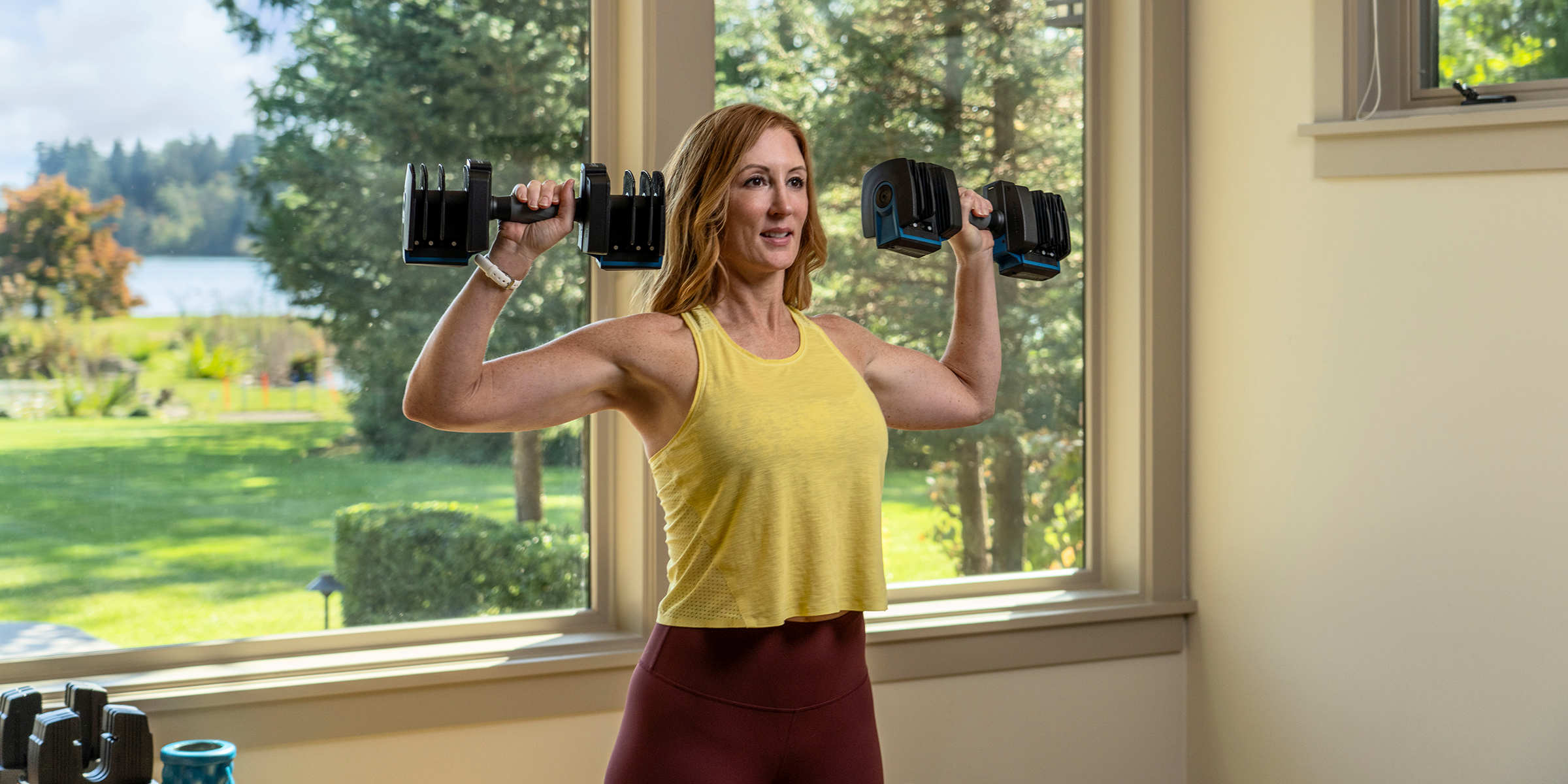
The ProFlex 432 Adjustable Dumbbells make it easy to dial up your weight in small increments, so you’re not forced to choose between staying at the same level or progressing too aggressively.
With the TeeterBell, progression isn’t about adding weight – it’s about how you use it. Different grip positions open up new exercises and movement patterns, helping you engage more muscle groups and build challenge in a more versatile way.
The Teeter Move app helps structure your progression over time, with guided workouts you can filter by equipment, intensity, and focus area. Instead of guessing when to increase the challenge, you can follow workouts designed to build gradually, layering in resistance, tempo, and volume in a way that stays manageable for your joints.
Because the sessions are structured and repeatable, it’s easier to track how your body responds over time, so you can recognize when you’re ready to progress and when it makes sense to hold steady.
Progress That Lasts
Strength training progress isn’t linear. It’s built through small adjustments, consistent effort, and knowing when to push forward and when to hold steady.
Paying attention to how your joints respond isn’t a limitation, it’s what allows you to keep progressing long-term.
The goal isn’t to push as hard as possible as quickly as possible. It’s to keep progressing in a way your body can sustain.
Keep Progressing Without Setbacks
Build strength at your own pace with joint-friendly equipment.

 Discover Teeter Blog